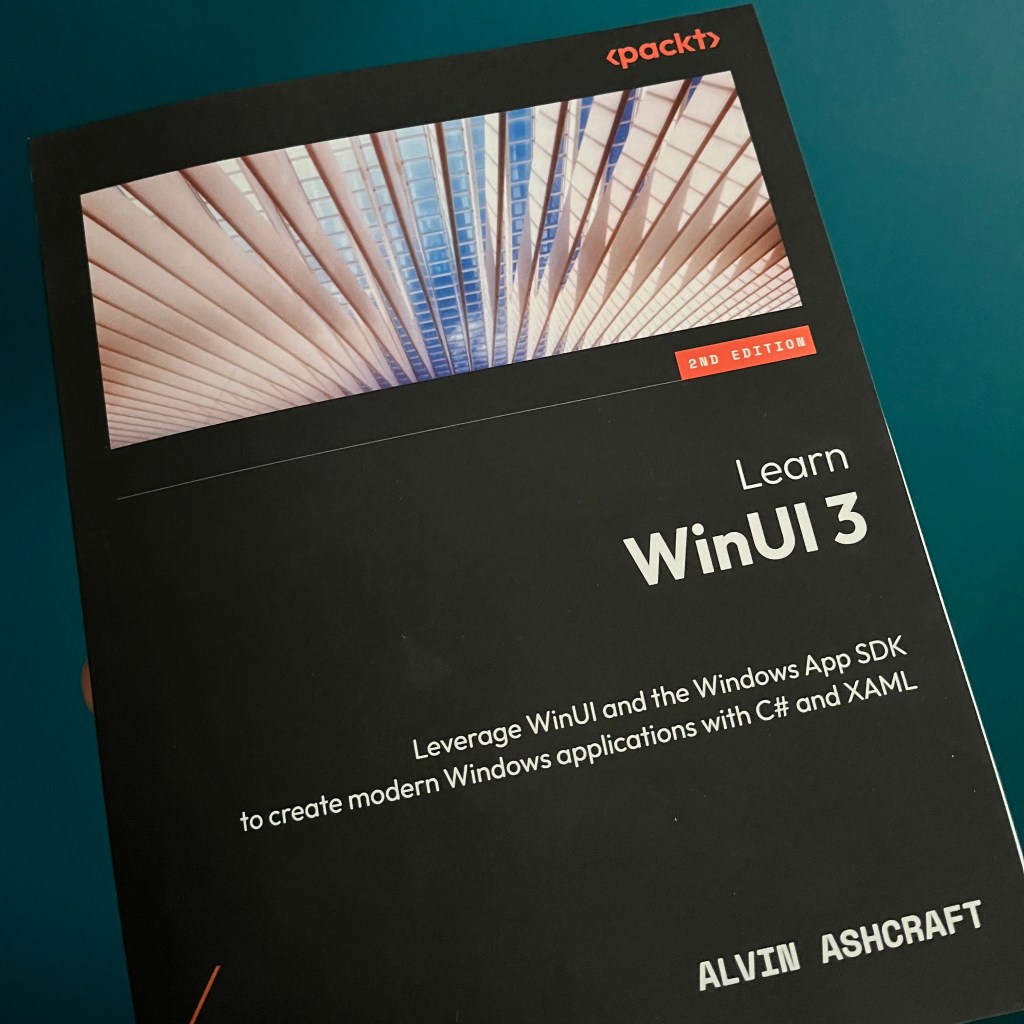
I received a physical copy of Alvin Ashcraft’s new WinUI book last week. I had the pleasure of being a technical reviewer for the book and it has been great to see it taking shape from the early chapters on WinUI history and core concepts through to delivering your completed app in the Microsoft Store. Along the way it even has chapters on interoperability with Blazor and going cross-platform with Uno. This allows you to apply the WinUI skills you learn throughout the book to a wide variety of device types.
I highly recommend it if you are interested in building apps for Windows and beyond using the latest XAML stack, fluent design and Windows SDK.
More details are available on the Packt website. It’s available through all the usual physical and online book sellers.
Jesse Liberty and Rodrigo Juarez have created this book to guide the reader through all aspects of creating apps with .NET MAUI. It assumes a level of experience with C# and .NET but is not limited to previous Xamarin developers. In fact while Xamarin Forms is mentioned it does not get in the way of the .NET MAUI discussion – this is very much a guide to how to create apps with what is available now.
The style is well structured and yet friendly in tone and throughout the book the code samples follow the creation of a single app from start to finish. Each chapter builds on the last and the code repository which accompanies the book contains branches at each chapter point in the book so that you can drop in at any point.
Importantly the book begins with setting up your development PC with the tools required to complete the app. When discussing configuring Visual Studio, Jesse admits that screens may change with Visual Studio updates – something which is always a hazard when writing a technical book.
While it mainly focuses on XAML and C#, it does venture into creating UI with C# and using fluent syntax to simplify this code. Beyond the .NET MAUI APIs themselves the book covers the Community Toolkit libraries which are a great set of resources beyond the core platform.
A whole chapter is dedicated to MVVM and using the latest MVVM Community Toolkit it shows how to quickly build ViewModels using code generators to handle all the boilerplate code required for properties to support change events. There are lots of notes covering things like naming conventions and project structure. These are both helpful and non-judgmental, recognising different approaches.
Each chapter ends with a clear summary and a set of quiz questions (if that’s your learning style).
Ultimately this is a great resource, both for an existing developer who wants to start with .NET MAUI, or for someone transitioning with prior experience of Xamarin Forms. There are plenty of code snippets and screenshots to illustrate each chapter. I definitely recommend this book if you want to become familiar with .NET MAUI.
Disclaimer: I received a free review copy of the eBook. No other consideration was provided for this review or the content thereof.
This title takes a traditional software programmer into the world of embedded system. It covers the process of designing and implementing an embedded system from a sketch through to optimising performance and power consumption.
As an interesting addition, at the end of each chapter, there is a potential interview question for an embedded developer position. It’s an unusual idea but is a way of tying up the topics covered in the chapter. Because the book is written for developers it applies patterns and techniques which the reader will already be familiar with and how they apply to embedded systems.
It emphasises the need to be aware of the limited resources available and how to pare down operations to a minimum to make best use of them. It also talks about various options for input and output for a variety of peripherals and sensors.
The book offers a useful introduction to the world of embedded development to a developer with existing C (or similar) experience. More experienced embedded developers will probably want to delve into more detail on the specific areas, but this is a great starting point.
Like Peter Nowak I was asked to review this recent release. Unfortunately due to other commitments it has taken the best part of a month to finish it. To avoid repeating the same points I recommend you read Peter’s review. While the current focus at Microsoft is on the upcoming Windows Phone 7 platform, we should not forget that there is still a demand for line of business applications for custom Windows CE platforms and Windows Mobile (and its Windows Embedded Handheld offspring) for enterprise devices.
I think the format of following a real-world application through the book provides a nice thread to tie together the various concepts described but often with this kind of approach you find features are shoe-horned in to show off a particular technology – a good example in this case is the IrDA/Bluetooth transfer of accounts between agents in a Sales application. Peter noted that the book does not describe the current situation with Visual Studio 2010 and why 2008 is needed for .NETCF 3.5 development but I think this is excusable based on the timescales involved in writing a book and how clearly this message was communicated by Microsoft.
The application design focuses exclusively on Windows Mobile and doesn’t cover issues when targeting other Windows CE platforms (such as Windows Mobiles enforced single-instance versus Windows CE default support for multiple instances of an application or just difference between the shells and screen layout). It also doesn’t cover form rotation and design for different DPI screens or implemented a locked-down kiosk mode. A personal gripe is the use of a SerialPort to do a Bluetooth transfer which is not the nicest solution, but then I suppose I’m biased.
Ultimately there is some good content in the book but it is unfortunately let down by being late to the party and the application scenarios try too hard to be all things to all people and ultimately not always 100% believable. It provides a starting point to work from and introduces a lot of functional areas from data synchronisation through to automatic update.
Despite Windows Phone 7 Development being all-the-rage at the moment I was recently informed of a new book on .NET Compact Framework development. I’ll be reviewing it shortly, in the mean time you can check out the details (including a free chapter download):-
Rob Miles has just blogged that his book “Embedded Programming with the Microsoft .NET Micro Framework” is currently on special offer at Computer Manuals through the MSDN Flash email newsletter. So if you have a wobbly table, or a door you want to prop open now is the time to buy (just kidding) 🙂
For exactly the same reasons you might want to grab the Mobile Development Handbook at 32% off. Alternatively if you just want some fun browsing the site then why not enter “Windows CE” into the quick search box. The only result is “The Johns Hopkins Manual of Gynecology and Obstetrics” an ideal addition to any mobile developers toolbox!
Finally on a related note I spotted that Doug Boling is working on an update of his Windows CE book due out in October – “Programming Windows® Embedded CE 6.0 Developer Reference“. Definitely worth adding to your wish list, even if you are primarily a managed code developer as it is important to know your way around the underlying OS.
Rob Miles, a fellow MVP who wrote one of the chapters for our book has grabbed a copy at DevDays in Amsterdam, you can see a picture of him proudly clutching the book in his latest blog post. In case you need any further encouragement to purchase the book beyond the 600+ pages of technical stuff, you’ll notice from Rob’s picture that carrying the book is also great for attracting a posse of female admirers 🙂
I travelled home yesterday to pick up my first copy of the book, it’s such a great feeling seeing the finished book after all this time. This was actually the first opportunity I got to read Rob’s chapter properly. As a guru of graphics and games development it’s no surprise that Rob does a great job of explaining Direct 3D Mobile.
Fellow MVP Wei-Meng Lee has finished a book on building applications with a range of networking technologies using .NET, both on the desktop and on devices. This covers the fundamentals of Sockets and Serial programming and contains a number of interesting projects incorporating webcams, fingerprint readers, RFID and GPS receivers.
The section on Infrared programming shows how to use the System.Net.Irda assembly in the Compact Framework and goes on to show how you can use exactly the same techniques on the desktop using the 32feet.NET library.
So far it’s been a fun read and I’m looking forward to trying out some of the projects just as soon as I find my fingerprint reader!


 In The Hand Ltd